After some research, I've found out that the colour the body is now is actually not lake placid blue (which is a "true blue", not a blue-green as I mistakenly claimed in my last post), but in fact a colour called "Ocean Turquoise", which is a custom colour that Fender offered from 1965 to 1971, and was found on 1965 Mercury cars. Check it out on the below pictures.
NB: For those of you who didn't know this, an interesting piece of info is that most original Fender finishes (apart from natural and suburst) are colours of car paint, and Fender bought their stocks of paint from DuPont and Ditzler just like the auto manufacturers did. Leo Fender was a huge fan of classic American automobiles (although at the time they were just "new" American automobiles), and the Fender colour selection has almost always reflected this.
In light of that, I've decided that for now at least I'll save myself some trouble and keep the Ocean turquoise finish, which I will lightly relic. I might make the guitar an Olympic White at some stage, but it seems almost a shame to spray over a finish that is today only available on a couple of US Reissue Fenders. Of course, that means it won't be as faithful to a '63 as I'd intended, so for the time being it'll just be a 196X strat.
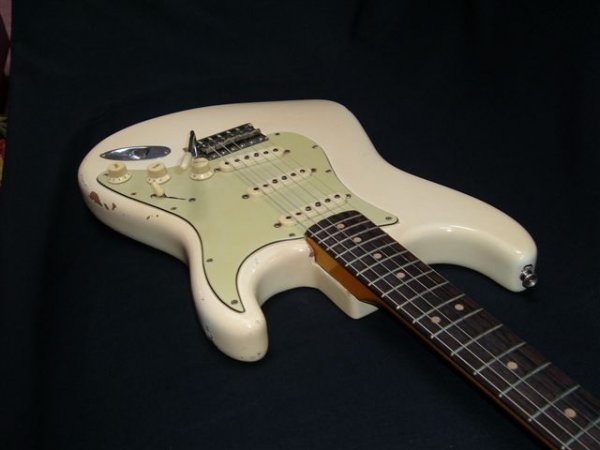
Anyway, here's an image of the body. Note that I've already started some of the relic work, which I'll explain in more detail.

Kind of hard to see in the pictures but perhaps most obvious is the wear in the paintwork. Relicing the finish of a guitar is the most delicate job, because it involves the most artistry. As countless articles about relicing have no doubt already told you, less is definitely more. If you take a sander to a guitar, you'll end up with a guitar that looks sanded, not old. Even some major brands and pro refinishers are guilty of over-relicing, producing scores of guitars that look like Hendrix used them for blowtorch practice. If you're planning on doing a relic job yourself, know that simulating the appearance of time takes, well, time. There is no quick-fix way of replicating the effect of decades of use wearing away at a finish, each handling taking off a microscopic layer of paint in an uneven but characteristic way. I DO use sandpaper, but very fine grade, which doesn't leave any discernable scratches, and sparingly. Almost immediately I turn to polish - not funiture polish, but the T-Cut type swirl remover stuff that contains tiny abrasive particles. What we're looking for here is patina, i.e. a specific type of slightly uneven shininess that you get on old objects that have been handled a lot.
What I haven't started doing on the paint, but I have started doing on the plastic is using stain. If you hang out on guitar forums you'll probably come across a bunch of threads about relicing, and one of the most popular topics is how to relic a strat pickguard. Almost everyone has their own method, ranging from soaking it in tea overnight to sticking it in the oven - and I'm sorry to say that they're almost all bullshit. A lot of people advise to not use stains because they don't stick. And it's true, they don't - that is, if you apply them only once, to the smooth surface of a new pickguard. You need to rough up the surface of the guard first, stain it, wipe the stain off, rough it up some more, restain, polish it up, restain, and so on, until you've reached the desired amount of dirt. You'll also need to smooth off the edges of the guard, get some dirt in the screw holes and so on. It's a gradual process, you don't want to get caught up in trying to do too much at once, because either it won't work at all, or it'll ruin the look of the pickguard. And bear in mind that you want to make it look real, so build up dirt only in places where a pickguard would naturally get dirty. It's always useful to find a picture of a real vintage guitar and use that as a reference.
The pickguard on my guitar is "mint green", which is a colour that emerged accidentally. Back in the day, 3-ply pickguards were made with materal that was slightly porous, and the dyes in the middle black layer would leech over time into the white layers, causing a kind of grey-green appearance. Modern plastics are not porous, so to get that vintage look manufacturers have started making the mint green colour to match. Of course, some have got it dramatically wrong and started making really green guards, which just look awful. Fortunately, the guard on mine was quite subtle, and the progressive application of some slightly red-brown stain has turned it a kind of textured parchment which look pretty authentic.
I've also started relicing the metalwork. Here's my recipe, which again is not a one-shot solution, but rather a progressive process. You'll need a sealable tupperware box, a smaller unsealed tupperware box, a bunch of salt and vinegar, and a warm radiator. You want to remove all the metalwork except for the springs and the bridge block, which should not be reliced.
1. Scuff the shine off the surface of the metal parts using a fine abrasive
2. Place all the metal parts into the large tupperware box and seal it
3. Shake the box for literally hours (this will give you the naturally scratching and pitting you'd get on old, well-used metalwork.)
4. Remove the metal parts from the box
5. Add three parts water to two parts vinegar to the large tupperware box, and a bunch of table salt (maybe 2 tbsp). You want this shallow enough that it doesn't come over the top of the smaller container. Shake the solution up.
6. Place metal parts in smaller open container, place this in the larger box
7. Sprinkle a few drops of the solution over the metal parts
8. Seal the box and place it on the radiator, or in direct sunlight, for two or three hours
9. Remove smaller box, place metal parts on a towel to dry - wipe off the largest rust spots that have formed.
10. Repeat steps 6-9 until the desired effect is achieved.
The following two photos are the result of me doing the above. I repeated steps 6-9 twice.


As you can see, the parts aren't rusted to shit, I've just taken the sheen off the top layer, started some oxidation, and made it look as if they've had good use and exposure to the elements for a few years. You could probably afford to do this a few more times if you wanted a dirtier look, but I wouldn't take it much further than that or it'll start to look fake - remember that the nastier you make your metalwork, the more you'll need to trash your paintwork, or it won't look right. People put new metalwork on trashed bodies, but they don't put rusty old metalwork on new bodies.
In my next blog I'll talk more about relicing the paintwork and underlying wood. Drop me a line if you have any questions.